What Does “Love” Mean in Tennis? Origin & Scoring Explained (2026)
Chris Davies | Lead Gear Tester Last Updated: March 08, 2026
RacketEdge is reader-supported. When you buy through our links, we may earn an affiliate commission.
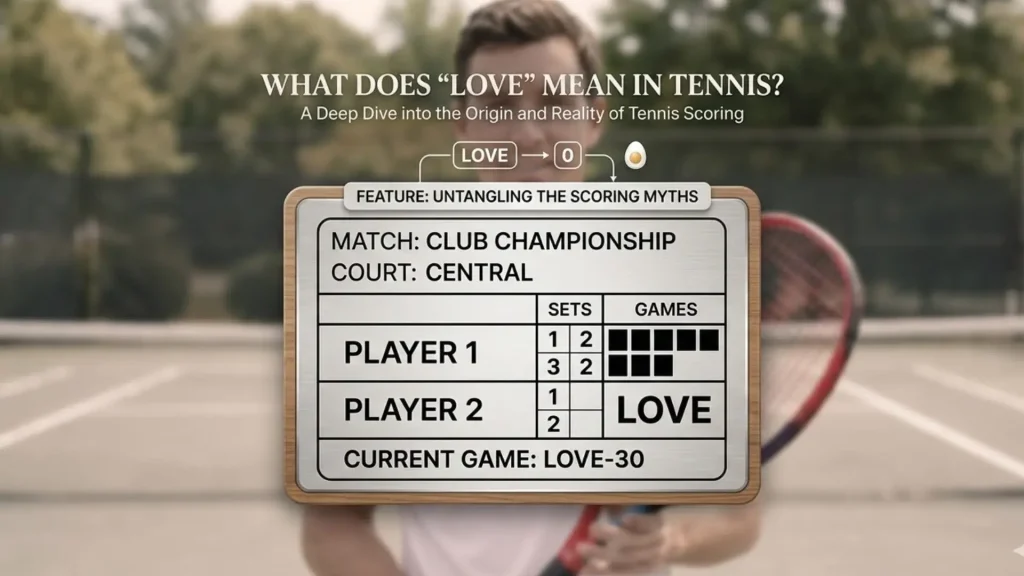
Tennis is a game of brutal physical endurance and sharp mental strategy, but to a beginner, the hardest part is often just trying to understand the scoreboard.
If you have ever tuned into Wimbledon or the US Open and heard the umpire declare “15-love” or “40-love,” you might have wondered what romance has to do with a racket sport.
As it turns out, nothing at all.
Before you step onto the court, you need to know how to keep score. Here is the exact meaning of “love” in tennis, where the bizarre term came from, and how the entire scoring system works.
The Quick Answer
In tennis, the term “love” simply means zero points. If the umpire announces a score of “15-love,” it means the server has won one point (15) and the receiver has zero points (love). When a match is just beginning and the score is 0-0, it is officially called “love-all.”
Where Did the Term “Love” Come From?
The origin of “love” in tennis has been debated by sports historians for decades. Today, there are two primary theories:
1. The French “Egg” Theory (Most Likely)
Tennis has deep roots in France. In the early days of the sport, the French used the word “l’œuf” (which translates to “the egg”) to represent a score of zero because an egg looks exactly like the number zero. When the game made its way to England, English speakers mispronounced l’œuf as “love.” Over time, the mispronunciation became the official rulebook term. Wikipedia
2. “For the Love of the Game”
The second theory is a bit more romantic. It suggests that if a player has zero points and is currently losing the match, they are no longer playing to win the prize money they are simply playing “for the love of the game.”
Read About: Let Rule in Tennis
How the Tennis Scoring System Works
To understand how “love” fits into a match, you need to understand the standard point progression in a single game of tennis.
Unlike basketball or soccer where points go up by ones, tennis uses a traditional, tiered scoring system:
- Love (0): Zero points.
- 15: One point won.
- 30: Two points won.
- 40: Three points won.
- Game: Four points won (Must win by two).
Always read the server’s score first. For example, if the person serving the ball has two points, and the person returning has zero points, the score is “30-love.”
Grand Slam
Don Budge was the first tennis player to win all four major tournaments in one year, achieving the Grand Slam in 1938 –
The Strategy of the Scoreboard
- When you are up 40-love: You have a massive psychological advantage. You only need one point to win the game. This is the perfect time to step up and go for a high-risk, aggressive kick serve or flat ace to close it out immediately.
- When you are down love-40: You are in survival mode. You cannot afford an unforced error. You need to focus on deep, heavy topspin groundstrokes to push your opponent back. (Pro Tip: If you struggle to generate depth under pressure, switching to a frame that offers “easy power” like the Yonex EZONE 100 can help you claw your way back into the point).
What Happens When the Score is Tied?
When players have the same score, the umpire does not use the word “love.” Instead, they use specific terminology to indicate a tie:
The “All” Rule
For early ties in the game, the word “all” is added to the point value:
- 0 – 0 is called “Love-all.”
- 15 – 15 is called “15-all.”
- 30 – 30 is called “30-all.”
The “Deuce” Rule
Things change when the score reaches 40 – 40. In tennis, you cannot win a game by just one point. If the score is tied at 40-40, it is called “Deuce.” From this point, a player must win two consecutive points to win the game.
- Ad-In (Advantage In): The server wins the first point after Deuce. If they win the next point, they win the game.
- Ad-Out (Advantage Out): The receiver wins the first point after Deuce. If they win the next point, they break the serve and win the game.
- If the player with the Advantage loses the next point, the score immediately resets back to Deuce.
FAQs
Why does tennis scoring skip from 30 to 40?
Historically, tennis scoring was tracked using a clock face (15, 30, 45, 60). However, the number 45 was eventually shortened to “40” simply because it was faster and easier for umpires to say out loud during fast-paced matches.
What does it mean to win a “Love Game”?
A “love game” occurs when one player wins all four points in a row, and the opposing player scores zero. The final point progression looks like this: 15-0, 30-0, 40-0, Game.
Does a tennis match start at love-love?
No. While both players start with zero points, the official terminology used by the umpire at the start of a match is “Love-all, play.”
What is a “Golden Set”?
A Golden Set in Tennis is an incredibly rare achievement where a player wins every single point in a set without dropping a single one (winning 24 consecutive points, resulting in a 6-0 set score).
Read about: Types of Tennis Shots
See you on the court,