11 Types of Tennis Shots Explained: How & When to Use Them
Chris Davies | Lead Gear Tester Last Updated: March 08, 2026
RacketEdge is reader-supported. When you buy through our links, we may earn an affiliate commission.

Tennis is not just about hitting the ball over the net; it is a game of physical chess.
If you are just hitting flat balls back and forth, a smart opponent will eventually tear you apart. To dictate the point, you need a full arsenal of shots: spin to push them back, slice to break their rhythm, and angles to finish the point.
After years of coaching and playtesting the 7 Best Tennis Rackets of the year, I’ve realized that the right gear only works if you know how to use it.
Here is your complete guide to the 11 essential types of tennis shots, including exactly what they are and when to pull the trigger.
Tennis Shots
1. The Groundstrokes (Baseline Play)
Groundstrokes are any shots you hit after the ball has bounced once on your side of the court. They are the foundation of modern tennis.
The Topspin Forehand / Backhand
- What it is: A shot hit by brushing up the back of the ball. This forward rotation creates air pressure that forces the ball to dive down into the court, allowing you to hit hard while keeping the ball in.
- When to use it: This is your “rally ball.” Use heavy topspin to keep your opponent pinned deep behind the baseline.
- Pro Tip: Topspin requires racket head speed. If you want to maximize your RPMs, an aerodynamic frame like the Yonex EZONE 100 practically does the work for you.
The Flat Groundstroke
- What it is: A shot driven straight through the ball with very little spin. The trajectory is laser-straight and low over the net.
- When to use it: Use this when you get a short ball and want to hit a clean winner. It removes reaction time from your opponent.
- The Danger: Because it lacks topspin, the margin for error is tiny. Aim for large targets, not the lines.
The Slice (Backhand or Forehand)
- What it is: A shot hit with an open racket face, chopping down and under the ball to create backspin. The ball floats low and skids upon bouncing.
- When to use it: Use the slice for defense when you are stretched wide, or to change the pace and disrupt an opponent who loves hitting fast, rhythmic balls.
- Pro Tip: Hitting a smooth slice requires a flexible, stable frame. If you struggle with arm pain when absorbing heavy pace on the slice, switching to one of the Best Tennis Rackets for Tennis Elbow will absorb that shock instantly.
2. The Serve (Starting the Point)
The only shot in tennis where you have 100% control over the ball. A great serve dictates the entire point.
The Flat Serve
- What it is: A fast, powerful serve hit with a flat racket face straight through the back of the ball.
- When to use it: Primarily on your First Serve to win free points (aces) or force weak returns.
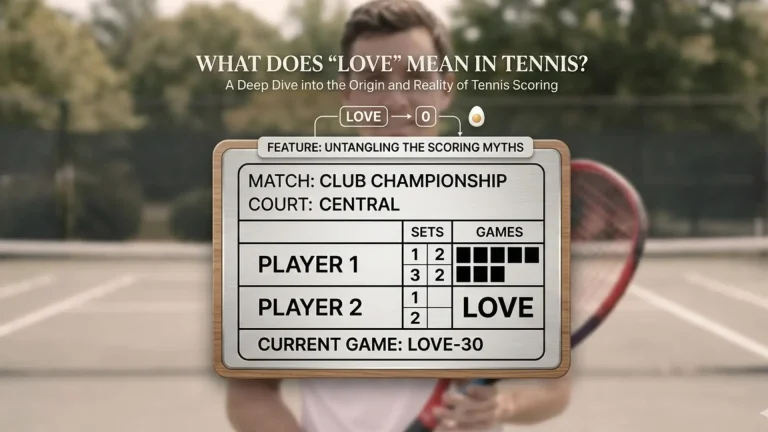
Learn More: What does love mean in tennis?
The Kick Serve (Topspin)
- What it is: A serve where you brush aggressively up and across the back of the ball. It bounces incredibly high, often kicking above the returner’s shoulder.
- When to use it: This is the ultimate Second Serve. The heavy spin makes it clear the net easily and drop safely into the box, preventing double faults.
The Slice Serve
- What it is: A serve hit by brushing around the side of the ball (like a curveball).
- When to use it: Use this out wide on the Deuce court (for righties) to drag your opponent completely off the court, opening up the entire other side for an easy winner.
3. The Net Game (Finishing the Point)
When you move inside the service line, you take away your opponent’s time. These shots require sharp reflexes.
The Volley (Punch)
- What it is: Hitting the ball out of the air before it bounces. A standard volley uses a short, compact punching motion—no backswing.
- When to use it: When you are at the net and the ball is driven at you above net level. Aim for the open court to finish the point instantly.
The Drop Volley
- What it is: A delicate volley where you loosen your grip at impact, absorbing the ball’s pace so it barely drops over the net.
- When to use it: When your opponent is pinned far behind the baseline and you get a low, manageable ball at the net.
The Overhead Smash
- What it is: A shot hit out of the air from above your head, using a motion identical to the serve.
- When to use it: When your opponent hits a defensive lob that falls short. It is the most lethal shot in tennis and should almost always end the point.
4. The Tactical Specialty Shots
These are the “trick” shots used to get you out of trouble or expose an opponent’s weakness.
The Lob
- What it is: A shot hit high into the air, deep into the opponent’s side of the court.
- When to use it (Defensive): When you are running out of breath and need 3 seconds to get back to the middle of the court.
- When to use it (Offensive): When your opponent rushes the net too closely. A topspin lob will fly right over their racket and bounce away for a winner.
The Drop Shot
- What it is: A groundstroke hit with extreme backspin and very soft hands, designed to bounce just inches over the net and stop dead.
- When to use it: When you notice your opponent is standing 10 feet behind the baseline, or if you are playing against a slower, heavier player who struggles to sprint forward.
FAQs
What are the 4 main Tennis shots?
The four foundational shots in tennis are the Serve, the Forehand, the Backhand, and the Volley. Mastering these four allows you to play a complete match at any level. Wikipedia
What is the hardest shot to hit in tennis?
The Backhand Smash is widely considered the hardest shot in tennis. It requires you to track a high ball over your non-dominant shoulder and hit it out of the air backward. Most pros opt to let it bounce or hit a defensive lob instead.
Which shot generates the most power?
The Flat First Serve generates the highest MPH of any tennis shot, followed closely by the flat forehand drive, because the player’s entire body weight transfers forward into a clean, un-spun impact.
How do I stop hitting the ball out?
Stop hitting flat. To keep the ball inside the lines, you need to brush up the back of the ball to create topspin. The spin creates air pressure that forces the ball to dive down into the court safely.
See you on the court,