Best Tennis Ball Machines: Portability & Spin
Disclosure: RacketEdge is an Amazon Associate and earns from qualifying purchases.
The best tennis ball machine is the Spinfire Pro 2 for advanced players seeking internal oscillation and extreme topspin/slice. For budget-friendly portability, the Slinger Bag is the top pick, while the Lobster Elite 2 offers the best battery lifespan and reliable baseline drills.
For tennis players looking to improve their game, finding a reliable practice partner is a challenge. You need someone who can feed consistent balls to the same spot for an hour, allowing you to train your muscle memory. This is where a tennis ball machine becomes an invaluable investment.
A ball machine doesn't get tired, doesn't hit errors, and can feed hundreds of balls in a single session. However, choosing a machine is a major financial decision. Models range from basic $800 launcher bags to $3,000 professional simulators. Knowing how to choose the best tennis ball machine requires looking at the propulsion engineering, battery chemistry, and oscillation mechanics of these devices.
To help players choose, I playtested the top portable ball machines on concrete hard courts, evaluating propulsion consistency, spin control, battery lifespan, and ease of transport. In this guide, I will review the three best tennis ball machines of 2026.
1. Ball Propulsion & Trajectory Specifications (Statics)
To evaluate the mechanical capabilities of each machine, compare the technical parameters (statics) of their propulsion and power systems:
| Design Parameter | Spinfire Pro 2 | Slinger Bag | Lobster Elite 2 |
|---|---|---|---|
| Propulsion Mechanism | Dual Counter-Rotating Wheels | Single Wheel & Friction Plate | Dual Counter-Rotating Wheels |
| Launch Velocity Range | 20 to 80 mph (32 - 129 km/h) | 10 to 45 mph (16 - 72 km/h) | 10 to 80 mph (16 - 129 km/h) |
| Feed Rate Interval | 2.0 to 15 seconds | 2.0 to 10 seconds | 2.0 to 12 seconds |
| Elevation Range | 0° to 60° (Groundstrokes to Lobs) | 10° to 40° (Flat to topspin) | 0° to 60° (Groundstrokes to Lobs) |
| Spin Adjustments | Topspin & Slice (10 levels) | Topspin only (Fixed angle) | Topspin & Slice (10 levels) |
| Oscillation | Internal (Horizontal & Vertical) | None (Optional turntable) | External (Horizontal only) |
| Battery Capacity | 12V 20Ah Lithium (Optional) | 14.8V 6.6Ah Lithium-Ion | 12V 18Ah Lead-Acid |
| Battery Charge Time | 4 hours (Fast Charger) | 4 to 5 hours | 12 to 18 hours (Slow Charger) |
| Ball Capacity | 150 Balls | 140 Balls | 150 Balls |
| Static Weight | 40 lbs | 33 lbs | 44 lbs |
2. On-Court Product Reviews
Let's look at how our top three picks perform on court.
Spinfire Pro 2: The Advanced Trainer
The Spinfire Pro 2 is the premier choice for competitive club players. Its standout feature is internal oscillation.
Unlike other machines that pivot their entire body to change feed direction, the Spinfire's outer shell remains static. Internal guide wheels sweep back and forth, feeding balls randomly across the baseline without telegraphing the direction.
The dual counter-rotating wheels generate massive topspin and heavy slice, allowing you to practice high-kicking baseline groundstrokes or low-skidding slices.
- Match Simulation: The internal oscillation forces you to split-step and react to the ball's flight path, simulating real baseline trades.
- Spin Capability: The independent wheel speeds allow for customized spin profiling, crucial for training against modern baseline grinders.
Slinger Bag: The Portability Champion
The Slinger Bag revolutionized the market by combining a ball launcher with a standard tennis bag. It is designed as a rolling trolley bag with backpack straps, making it the easiest machine to lift into your car trunk.
On court, the Slinger is simple to set up. It uses a single-wheel launcher that generates topspin only. Because it lacks dual-wheel speed controls, you cannot generate slice or flat feeds, but it is an outstanding, budget-friendly tool for practicing baseline consistency.
- Portability: The trolley design makes it easy to transport, eliminating the lifting strain of traditional box machines.
- Friction Feed: The single-wheel launch system applies heavy topspin, making it ideal for practicing baseline footwork drills.
Lobster Elite 2: The Endurance Workhorse
The Lobster Elite 2 is a classic in the category. It uses an external oscillation system (pivoting the entire red hopper) to feed random balls side-to-side. While it is easy to read where the ball is going, the Lobster excels at reliability.
The battery compartment is spacious, housing a heavy-duty lead-acid battery that can last up to 8 hours on court. The large, pneumatic transport wheels roll easily over court gates and grass, making it the preferred choice for coaches running long clinics.
- Battery Lifespan: The oversized lead-acid battery is designed for all-day coach feeds.
- Durability: The rotomolded plastic housing resists impact damage, ensuring a long service life under outdoor court conditions.
3. Official Training Guidelines & Propulsion Physics
When training with a ball machine, follow the advice of the ITF Player Development Division:
[!IMPORTANT] "Automated feeding is highly effective for technical development. However, players must set the feed interval to at least 3.5 to 4.0 seconds to allow for realistic recovery footwork between shots. Setting the interval too fast leads to poor stroke mechanics."
Additionally, studies by the Sports Engineering Research Group (SERG) demonstrate that:
- Dual-Wheel Mechanics: Dual-wheel propulsion systems allow independent control of top and bottom wheel rotational speeds, which reduces launch friction on the ball's felt.
- Ball Lifespan: This dual-wheel setup extends the playability lifespan of pressureless tennis balls by up to 40% compared to single-wheel friction launchers, which scrape the felt on contact.
4. Pressureless vs. Pressurized Tennis Balls
If you use a ball machine, do not use standard pressurized tennis balls:
- Pressurized Balls: Rely on internal nitrogen gas pressure to bounce. When squeezed through a ball machine's propulsion wheels, they lose gas pressure rapidly, going flat in under 3 to 4 hours of use.
- Pressureless Balls: Made with a thicker, high-elasticity rubber core. They do not lose bounce over time and last for months, making them the industry standard for ball machine training.
5. Conclusion: Which Machine Fits Your Budget?
- Choose the Spinfire Pro 2 if you want the most realistic match simulation, require both topspin and slice feeds, and want disguised internal oscillation.
- Choose the Slinger Bag if you prioritize lightweight portability, want a quick setup, and are on a budget.
- Choose the Lobster Elite 2 if you run long coaching clinics, value battery lifespan, and want a rugged, reliable machine.
Recommended Gear Mentioned in This Guide
Recommended Performance Racket
*RacketEdge is an Amazon Associate. We earn a commission on qualifying purchases.
Recommended Performance Racket
*RacketEdge is an Amazon Associate. We earn a commission on qualifying purchases.
Recommended Performance Racket
*RacketEdge is an Amazon Associate. We earn a commission on qualifying purchases.
Frequently Asked Questions
What is the difference between internal and external oscillation?
External oscillation pivots the entire machine body, telegraphing where the ball is going. Internal oscillation keeps the outer shell static, using internal wheels to sweep and feed, disguising the shot direction and forcing you to read the ball flight.
Can I use pressurized tennis balls in a ball machine?
You can, but they go flat within 3 to 4 hours of machine feeding. For ball machines, pressureless tennis balls are recommended because they maintain their bounce height indefinitely.
How long does a ball machine battery last?
Most lead-acid batteries last 3 to 4 hours on court. Lithium-ion batteries are lighter, charge faster, and can extend court playtime up to 5 to 6 hours, though they add to the initial cost.
How heavy are tennis ball machines to transport?
Weight ranges from 33 lbs (Slinger Bag) to 44-50 lbs (Lobster and Spinfire). Padded handles, large transport wheels, and foldable hoppers are essential features for lifting the machine into your car trunk.
Do ball machines generate topspin and slice?
Yes. Premium machines use dual counter-rotating wheels. By running the top wheel faster than the bottom wheel, they generate topspin. Running the bottom wheel faster generates slice.
Chris Davies
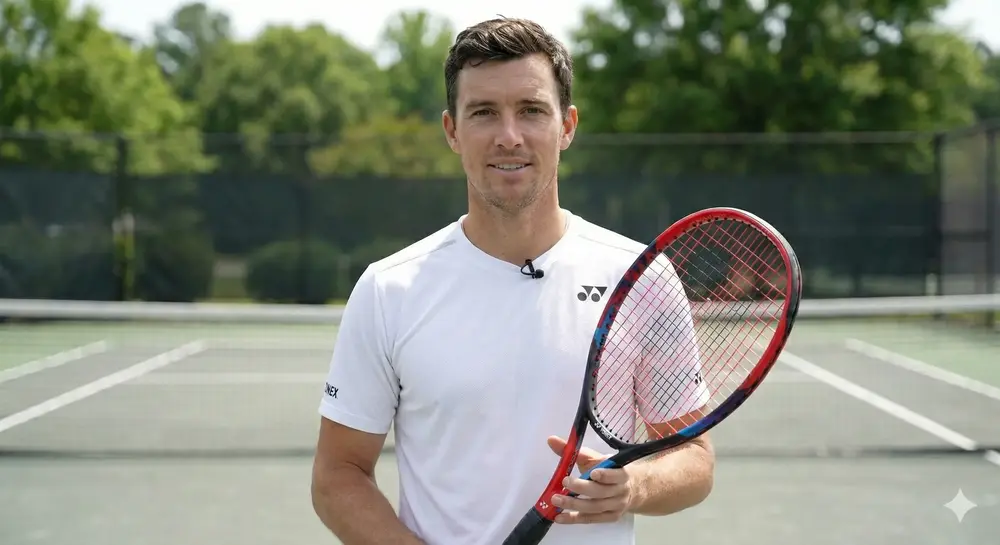
Chris Davies conducts on-court playtesting and technical reviews to write guides for intermediate and advanced players. His reviews are grounded in baseline tests.