How to Play Tennis for Beginners: Start Guide
Disclosure: RacketEdge is an Amazon Associate and earns from qualifying purchases.
To play tennis as a beginner, choose a lightweight racket, learn the Continental and Eastern grips, master the four basic strokes (forehand, backhand, serve, and volley), and understand the 15-30-40 scoring system to play your first set.
Tennis is one of the most rewarding sports you can play. It is a lifetime sport that builds cardiovascular fitness, agility, and mental toughness. Unlike gym workouts, tennis is a physical game of angles and strategy—a physical chess match played on painted concrete, grass, or clay.
However, walking onto a court for the first time can feel overwhelming. The rules seem complex, the scoring system makes no sense (with terms like "love" and "deuce"), and simply coordinating your swing to hit a bouncing yellow ball can be difficult. Knowing how to play tennis for beginners requires a structured approach to gear, grips, and basic strokes.
Fortunately, learning tennis doesn't require natural athleticism. With the correct gear, a basic understanding of grips, and a focus on simple stroke mechanics, you can start rallying with a partner in your first week. In this beginner's guide, I will break down the quick-start steps you need to take.
1. Court Dimensions & Equipment Reference (Statics)
To familiarize yourself with the physical layout of the game, review the official court dimensions and beginner ball progression parameters (statics):
| Court / Equipment Metric | Standard Specification | Playability Purpose |
|---|---|---|
| Court Length | 78 feet (23.77 meters) | Total baseline-to-baseline boundary length |
| Singles Width | 27 feet (8.23 meters) | Boundary width for 1-vs-1 matches |
| Doubles Width | 36 feet (10.97 meters) | Boundary width including the outer alleys |
| Net Height (Center) | 3.0 feet (36 inches / 91.4 cm) | Height of the net at its lowest point (center strap) |
| Net Height (Posts) | 3.5 feet (42 inches / 107 cm) | Height of the net at the support posts |
| Service Box Length | 21 feet (6.40 meters) | Target box length for a legal serve |
| Stage 3 Red Ball | 75% slower, 8.0cm diameter | Felt or foam, low bounce for learning strokes |
| Stage 2 Orange Ball | 50% slower, 6.4cm diameter | Low-compression rubber, for mid-court rallies |
| Stage 1 Green Ball | 25% slower, 6.4cm diameter | Mid-compression rubber, for full-court rallies |
| Standard Yellow Ball | 100% speed and bounce | High-compression core, standard adult tennis ball |
2. Choosing Beginner-Friendly Gear
Before you hit the court, you need the correct equipment. Using advanced tournament gear as a beginner will stunt your progress:
- The Racket: Choose an oversize head (100 to 105 square inches) to provide a forgiving sweet spot. Look for a lightweight frame weighing under 10.5 ounces unstrung. This allows you to swing without straining your shoulder and elbow joints.
- The Strings: Avoid stiff polyester strings. Use soft nylon synthetic gut or multifilament strings, strung at the lower end of the frame's recommended tension range (usually 50 to 52 lbs) to maximize comfort.
- The Footwear: You must wear tennis-specific court shoes. Running shoes feature thick, soft midsoles designed only for forward movement. They lack lateral support, making them an ankle-roll hazard during side-to-side court sprints.
3. The Handshake Grip: Eastern Forehand
To control the ball, you must hold the racket correctly. Racket handles are octagonal, featuring 8 flat sides called bevels. The easiest grip to learn is the Eastern Forehand Grip:
- Hold the racket frame with your non-dominant hand, pointing the handle toward your chest.
- Place the palm of your dominant hand flat against the string bed.
- Slide your hand down the shaft until you grab the handle.
- It should feel like you are shaking hands with the racket handle.
Your index knuckle should rest on bevel 3 (the vertical right face of the handle). This grip provides a natural, flat racket face on contact, making it easy to hit consistent forehands.
4. The ITF Ball Progression Strategy
If you struggle to hit standard yellow balls, follow the guidelines of the ITF Play and Stay Campaign:
[!IMPORTANT] "Beginner players should start with slower Stage 3 (Red), Stage 2 (Orange), or Stage 1 (Green) low-compression balls. Using slower, lower-bouncing balls increases average rally length, accelerating stroke development and making learning tennis fun and accessible."
According to coaching manuals published by the United States Tennis Association (USTA):
- Red Ball Stage: Played on a mini 36-foot court. This stage allows beginners to develop hand-eye coordination and short swings.
- Orange Ball Stage: Played on a 60-foot court. Orange balls travel 50% slower than yellow balls, allowing players to learn swing loops.
- Green Ball Stage: Played on a full 78-foot court. Green balls travel 25% slower than yellow balls, serving as a transition to standard play.
5. Mastering the 4 Basic Strokes
To play a baseline rally, you must learn the four core tennis strokes:
The Forehand
Hit on your dominant side. Set your feet sideways, take the racket back early in a loop motion, strike the ball out in front of your body at hip height, and follow through over your opposite shoulder.
The Backhand
Hit on your non-dominant side. Beginners are highly recommended to use a two-handed backhand. Place your dominant hand at the bottom of the grip and your non-dominant hand above it. Swing upward, utilizing your non-dominant arm to push the racket through the ball.
The Serve
The shot that starts every point. Stand behind the baseline at an angle. Toss the ball straight up in front of your hitting shoulder, swing the racket up and over your head, and strike the ball at the highest point of your reach.
The Volley
Hit out of the air before the ball bounces, usually when you stand near the net. Keep your backswing extremely short—think of it as a block or a punch rather than a full swing.
6. Understanding the Basics of Court Lines
Before you play a match, you must know what lines are in and out:
- The Baseline: The back boundary line of the court.
- The Singles Sideline: The inner side lines. For singles play, the outer alleys are out of bounds.
- The Net: A ball that hits the net but lands inside the opponent's court is playable (except during serves, which are called "lets").
- Line Calls: If any part of the ball touches the white line, the ball is considered in. In tennis, players call the lines on their own side of the net. Be honest and fair with your calls.
7. Conclusion
Learning to play tennis is a experience of muscle memory and patience. Don't worry about hitting the ball hard initially. Focus on consistent, relaxed swings, lock your eyes on the ball until it hits your strings, and practice footwork. Within a few weeks, you will be trading baseline rallies and playing your first match sets.
Recommended Gear Mentioned in This Guide
Recommended Performance Racket
*RacketEdge is an Amazon Associate. We earn a commission on qualifying purchases.
Recommended Performance Racket
*RacketEdge is an Amazon Associate. We earn a commission on qualifying purchases.
Recommended Performance Racket
*RacketEdge is an Amazon Associate. We earn a commission on qualifying purchases.
Frequently Asked Questions
What size tennis racket does a beginner need?
Beginners should look for an oversize racket with a head size between 100 and 105 square inches. The frame should weigh between 9.5 and 10.5 ounces unstrung to allow easy swinging without arm fatigue.
What is the easiest tennis grip to learn?
The Eastern Forehand Grip is the easiest for beginners. Place your index knuckle on bevel 3 of the handle. It feels like shaking hands with the racket, returning a flat, natural hitting angle.
Can a beginner play with polyester strings?
No. Polyester strings are stiff and require high swing speeds to generate power. Beginners should use synthetic gut or multifilament strings, which are softer, more elastic, and easier on the elbow.
How long does it take to learn tennis?
With weekly lessons and practice sessions, most beginners can learn to rally consistently from the baseline and play casual matches within 3 to 6 months.
Is tennis a good workout for beginners?
Yes. Tennis is an outstanding cardiovascular workout that builds leg strength, core stability, and agility through short bursts of high-intensity lateral sprinting.
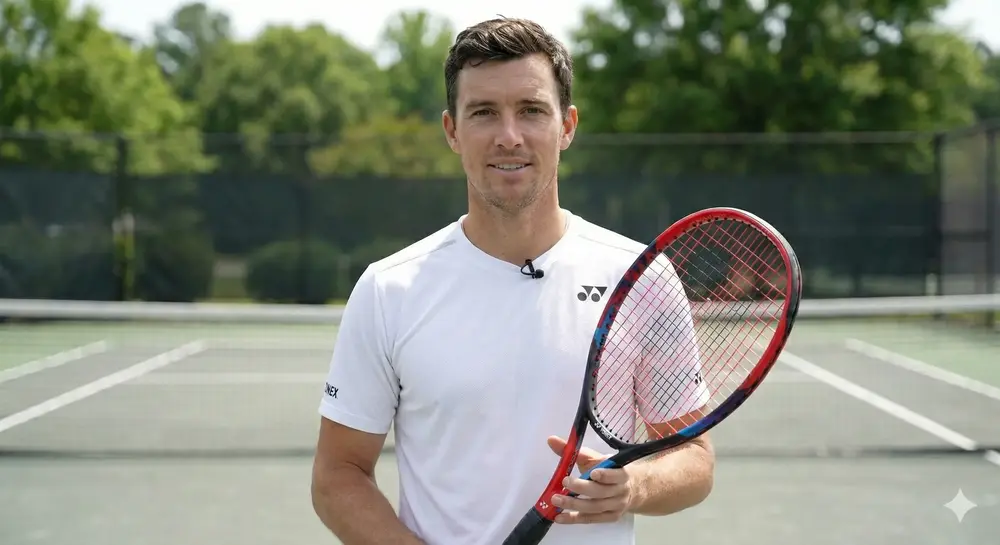
Chris Davies
Chris Davies conducts on-court playtesting and technical reviews to write guides for intermediate and advanced players. His reviews are grounded in baseline tests.