What Causes Tennis Elbow? Prevention Guide
Disclosure: RacketEdge is an Amazon Associate and earns from qualifying purchases.
Tennis elbow (lateral epicondylitis) is caused by repetitive micro-tears in the ECRB tendon due to forearm muscle overload. In tennis, this is triggered by stiff carbon racket frames, high-tension polyester strings, off-center ball strikes, and poor stroke mechanics like leading with a bent wrist.
[!WARNING] Disclaimer: The information in this guide is for educational purposes only and does not constitute medical advice. Always consult a qualified physician or physical therapist before starting any rehabilitation exercises or treating joint pain.
Ask any group of active tennis players, and they will tell you about tennis elbow (lateral epicondylitis). It is the most common joint injury in racquet sports, affecting up to 50% of recreational players at some point in their playing careers. Knowing what causes tennis elbow is the first step toward effective treatment, prevention, and long-term joint health.
The pain starts as a mild ache on the outer bony bump of the elbow. Within weeks, it intensifies into a sharp, burning pain that makes it difficult to swing a racket, lift a grocery bag, or even shake hands. Many players assume that tennis elbow is simply muscle soreness that can be ignored or treated with a basic sleeve.
In this guide, I will break down the biomechanics of what causes tennis elbow, explain how racket frame and string selection contribute to joint shock, and share recovery tips.
1. Biomechanical Tendon Strain & Shock Absorption (Statics)
To understand tendon loading and equipment shock absorption, review the technical parameters (statics) of elbow injuries and frame engineering:
| Diagnostic / Equipment Metric | Healthy Joint Value | Injured Joint Value | Biomechanical Significance |
|---|---|---|---|
| ECRB Tendon Thickness | 4.0mm to 5.0mm | >6.5mm (Swollen/Hyperplasia) | Indicates chronic degeneration (tendinosis) |
| Micro-Tear Strain Limit | Under 3% tendon extension | Exceeding 4% tendon extension | The stretch limit at which collagen fibers tear |
| Peak Impact Shock | ~28g acceleration force | ~45g acceleration force (Stiff) | High shock acceleration overloads wrist stabilizers |
| Stringbed Elasticity | ~55 N/mm (Multifilament) | ~100 N/mm (Stiff Polyester) | Stiff strings transfer impact force to the arm |
| Grip Squeeze Pressure | Baseline grip force | +35% squeeze force (Slick grip) | Higher squeezing forces fatigue extensor tendons |
| Recurrence Rate | Baseline risk | Up to 50% recurrence in 1 year | Higher without eccentric muscle rehabilitation |
| Vibration Frequency | <140 Hz (Damped frame) | >180 Hz (Rigid frame) | High frequencies damage vascular networks |
| Dynamic Stiffness (DT) | <35 DT (Soft stringbed) | >45 DT (Board-like stringbed) | Controls the impact deceleration curve |
2. Biomechanics: The Extensor Muscle Overload
To understand tennis elbow, you must look at the anatomy of your forearm. The Extensor Carpi Radialis Brevis (ECRB) muscle stabilizes the wrist when your hand is clenched, such as when you grip a tennis racket. When you strike a tennis ball, your wrist must remain firm. The ECRB tendon absorbs the impact force.
If your racket hits off-center, or if your strings are too stiff, the resulting vibration forces the ECRB muscle to contract violently, causing micro-tears at the bony insertion point.
According to clinical definitions from the Mayo Clinic:
[!IMPORTANT] Pathology of Tennis Elbow: "Tennis elbow is not an active inflammatory condition (tendinitis) but rather a degenerative tendon condition (tendinosis). It is characterized by disorganized collagen fibers, lack of inflammatory cells, and neovascularization (the growth of weak, non-functional blood vessels)."
Additionally, the American Academy of Orthopaedic Surgeons (AAOS) states:
- Demographics: Overuse of the forearm extensor muscles due to poor swing mechanics and rigid equipment affects up to 50% of all tennis players during their lifetime. It is most common in players between the ages of 30 and 50.
- The Healing Challenge: Because tendons have a poor blood supply compared to muscles, they heal slowly. Continuing to play through pain causes micro-tears to rebuild with weak scar tissue, making the tendon prone to chronic tearing.
3. Gear Factors: Rackets, Strings, and Dampeners
Many players suffer from tennis elbow because they play with gear that is too stiff for their arm strength:
- Frame Stiffness (RA Rating): Stiff frames (RA 68+) offer high power but do not flex on impact, transmitting the shock wave down the handle. Flexible frames (RA 63 or lower) bend slightly on impact, absorbing kinetic energy and protecting your joints.
- String Selection: Stiff polyester strings (like Luxilon Alu Power) do not stretch easily. If you string polyester at high tensions (above 52 lbs), your string bed will behave like a board. Switch to elastic multifilament or natural gut strings at lower tensions (48-52 lbs) to cushion the impact.
- The Dampener Misconception: Small rubber vibration dampeners placed in the strings do not prevent tennis elbow. They only absorb high-frequency sound waves in the strings (the "ping" sound), having no impact on the heavy, low-frequency frame vibrations that travel down the handle.
4. Rehabilitation: The Power of Eccentric Loading
Because chronic tennis elbow is a degenerative condition, rest alone is rarely enough to heal the tendon. You must stimulate the tendon to rebuild healthy, aligned collagen fibers:
- Eccentric Training: Exercises where the muscle elongates under tension are the gold standard for tendon rehabilitation.
- The Tyler Twist: Using a rubber resistance bar (like a Theraband FlexBar), perform the Tyler Twist drill for 3 sets of 15 repetitions daily. This movement forces the ECRB tendon to work eccentrically, stimulating collagen remodeling and rebuilding tendon strength.
5. Conclusion
Tennis elbow is a structural warning sign that your forearm tendons are overloaded. To recover, combine active rest and stretching with a gear review: switch to a flexible frame, replace stiff polyester strings with elastic multifilaments at a lower tension, and focus on striking your backhand out in front of your body.
Recommended Gear Mentioned in This Guide
Recommended Performance Racket
*RacketEdge is an Amazon Associate. We earn a commission on qualifying purchases.
Recommended Performance Racket
*RacketEdge is an Amazon Associate. We earn a commission on qualifying purchases.
Recommended Performance Racket
*RacketEdge is an Amazon Associate. We earn a commission on qualifying purchases.
Frequently Asked Questions
Can a cheap tennis racket cause tennis elbow?
Yes. Cheap rackets are often made of stiff aluminum or low-grade carbon composites that do not absorb vibration. This unmitigated shock wave travels directly down the handle to your forearm muscles.
Which string type is best for preventing tennis elbow?
Natural gut or premium multifilament strings are the best choices. They are highly elastic and stretch easily on impact, absorbing the ball's kinetic energy so your arm muscles don't have to.
How does play technique affect tennis elbow?
Hitting late backhands is a primary trigger. If you strike the ball behind your body, you must bend your wrist to support the impact, overloading the extensor muscles. Always strike the ball out in front.
Should I rest completely if I have tennis elbow?
Active rest is recommended. Stop playing tennis to allow the micro-tears to heal, but perform gentle stretching, eccentric exercises (like Tyler twists with a bar), and maintain forearm blood flow.
Does ice or heat help tennis elbow?
Ice helps reduce acute inflammation and numb pain during the first 48 hours after a flare-up. Heat is better for chronic pain, as it increases blood flow and relaxes stiff muscles before stretching.
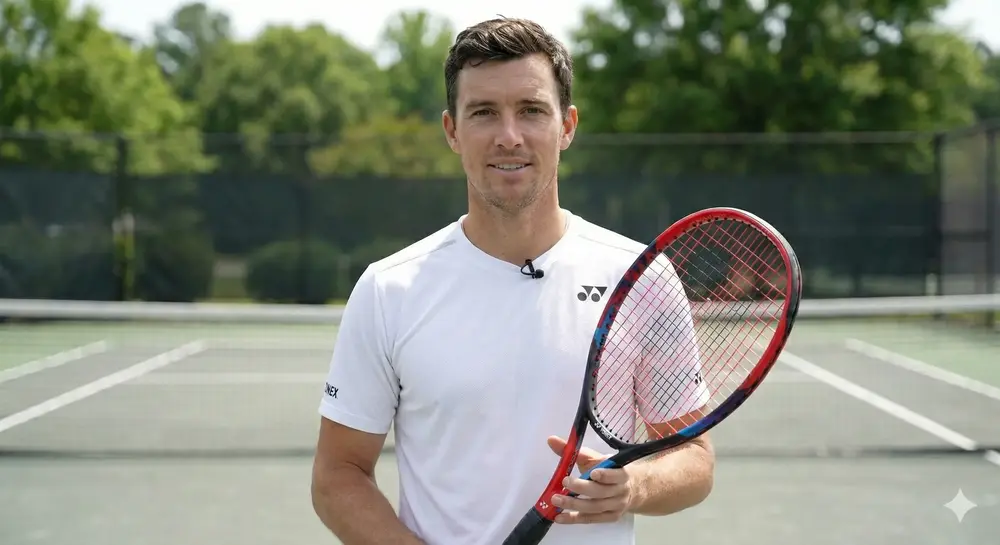
Chris Davies
Chris Davies conducts on-court playtesting and technical reviews to write guides for intermediate and advanced players. His reviews are grounded in baseline tests.