Why Do Pros Restring Every Match? ATP Habits
Disclosure: RacketEdge is an Amazon Associate and earns from qualifying purchases.
Professional players restring their rackets before every match to ensure exact, consistent string tension. Modern co-polyester strings lose 10% of their tension within hours of being strung and go 'dead' after 2 to 3 hours of heavy hitting, altering the launch angle and control.
If you watch a Grand Slam match, you will notice a player walking to their bag during a changeover, pulling out a fresh racket wrapped in a sealed plastic bag, and handing their played racket to a court runner. The runner sprints to the tournament stringing room, where a technician will cut out the strings and restring the frame immediately.
For a recreational club player who restrings their racket once or twice a year, this looks like extreme superstition or professional pampering. But for professional ATP and WTA players, restringing before every match—and even during a match—is a tactical necessity.
Professional players swing at head speeds exceeding 80 mph, generating spin rates above 3,200 RPM. At this level of play, minor deviations in string tension alter ball control, resulting in shot depth errors that decide matches. In this guide, we will look at the physics of tennis strings under tension, explain the science of tension loss and structural fatigue, explore the connection between ball changes and racket rotation, and show you why pros cannot play with day-old strings.
1. The Physics of Tension Loss: Static vs. Dynamic
To understand why pros restring constantly, we must look at the behavior of tennis strings under high tension. When a string is pulled, it undergoes two types of deformation: elastic deformation (which is temporary and returns energy) and plastic deformation (which is permanent and degrades playability).
Static Tension Loss (The 24-Hour Drop)
Once a racket is strung and tied off, the strings begin to relax. This is known as static tension loss, and it occurs even if the racket sits unused in a bag. The polymer chains in synthetic strings gradually slide past one another, relaxing the tension. A co-polyester string bed will lose 10% to 15% of its tension within 24 hours of being strung.
For a professional player who relies on precise depth control, this 10% drop changes the launch angle. A ball that would have landed 3 inches inside the baseline with a fresh setup will sail 3 inches long with a day-old setup. This is why pros demand their rackets be strung the morning of the match.
Dynamic Tension Loss (The Impact Drop)
When the match begins, the strings undergo dynamic tension loss. Every time a player strikes a ball with a 100 mph swing, the strings deflect and slide. The impact forces stretch the string molecules beyond their elastic limit, leading to permanent plastic deformation. Within 45 minutes of heavy hitting, the tension drops by another 3 to 5 pounds.
As the United States Racquet Stringers Association (USRSA) notes:
"A professional tennis player strikes the ball with such force that the polymer structure of co-polyester strings undergoes irreversible mechanical deformation. Within 45 minutes to an hour of play, the string bed loses its elastic memory, transitioning from a crisp control engine to a dead, vibration-inducing board."
2. Technical Specifications: String Material Tension Profiles
Different string materials handle tension loss differently. The table below breaks down the major string types, their degradation rates under professional use, and their playable lifespan.
| String Material | Static Tension Loss (First 24 Hours) | Dynamic Tension Loss (Per Hour of Pro Play) | Elasticity Retention Profile | Average Playable Lifespan (Pro Level) | Recommended Pro Tension Range |
|---|---|---|---|---|---|
| Natural Gut (Organic) | ~5% (Excellent) | ~2% (Very Low) | High (maintains elasticity until breakage) | 4 – 6 hours | 54 – 62 lbs (24.5–28 kg) |
| Co-Polyester (Monofilament) | ~12% – 15% (High) | ~8% – 10% (Very High) | Low (goes dead quickly due to plastic deformation) | 1.5 – 3 hours | 42 – 52 lbs (19–23.5 kg) |
| Nylon Multifilament | ~8% (Good) | ~4% (Moderate) | Medium-High (gradual degradation) | 3 – 5 hours | 52 – 60 lbs (23.5–27 kg) |
| Synthetic Gut (Nylon) | ~10% (Moderate) | ~6% (High) | Medium (standard wear) | 2 – 4 hours | 50 – 58 lbs (22.5–26 kg) |
| Kevlar (Aramid) | ~20% (Very High) | ~12% (Extreme) | Very Low (extremely stiff from start) | 2 – 3 hours | 40 – 46 lbs (18–21 kg) |
The International Tennis Federation (ITF) player development manual states:
"Equipping players with identical racket setups is a cornerstone of performance stability. A tension variation of even two pounds can lead to depth differences of several inches, highlighting why tournament stringers must pull tension to within 0.1 pounds of accuracy."
3. The "Dead String" Hazard: Losing the Spin Engine
When a string loses its elasticity, it is referred to as going "dead." For recreational players, a dead string is an annoyance; for a professional, it is a game-breaker.
When co-polyester strings go dead:
- Snapback Stops: Polyester strings generate topspin by sliding out of position and snapping back dynamically. When they go dead, they lose their slickness and elasticity, sticking in place and reducing spin by up to 20%.
- Launch Angle Rises: As the string bed loses tension, the ball pocketing becomes deeper and less predictable. The launch angle increases, causing groundstrokes to fly long.
- Vibrations Increase: A dead polyester string bed behaves like a rigid sheet of plastic. Instead of absorbing shock, it transmits high-frequency vibrations directly to the player's wrist, elbow, and shoulder, rising the risk of tendonitis.
4. The Ball Change Connection: The 9-Game Racket Rotation
If you watch closely, you will see pros pull out a fresh racket at the same time new balls are introduced. This is not a coincidence; it is a calculated tactical adjustment.
In professional matches, balls are replaced after the first 7 games (to account for the warm-up) and every 9 games thereafter.
- Fresh Balls: Are stiff, pressurized, and fast. They bounce higher and fly faster through the air.
- Worn Balls: Become soft, lose pressure, and fluff up, increasing drag and slowing down.
To control the extra speed and bounce of new balls, a pro needs a firm, crisp string bed. By switching to a freshly strung racket from their bag at the ball change, they match the fresh ball with fresh strings that have maximum control. As the balls wear down and slow down over the next nine games, the strings relax at a similar rate, keeping the depth of the player's shots consistent.
5. The Grand Slam Stringing Room: High-Pressure Customization
During a Grand Slam, the tournament stringing room operates 24 hours a day, processing up to 500 rackets daily.
- Constant-Pull Calibration: Electronic machines pull tension slowly and maintain the pull until the knot is tied. This ensures that a request for 51.5 lbs is delivered exactly.
- Pre-Stretching: Some players request their strings (especially natural gut) be pre-stretched by 5% to 10% on the machine. This pulls out the initial static stretch, stabilizing the tension so it does not drop during their match.
- Environmental Protection: Once strung, rackets are immediately sealed in airtight plastic bags. This protects the string bed from humidity and temperature changes in the locker room, ensuring the tension is preserved until the player cuts the bag open on court.
6. Summary Recommendations for Club Players
While recreational players do not need to restring before every match, they can learn from the habits of the pros:
- Avoid Dead Polyester: If you play with polyester strings, do not leave them in your racket for six months. Even if they do not break, they go dead and lose their playability within 10 to 12 hours of play. Cut them out and restring to protect your arm.
- The Restring Frequency Rule: A good rule of thumb for club players is to restring your racket as many times per year as you play per week (e.g., if you play 3 times a week, restring at least 3 times a year).
- Store Rackets Safely: Keep your rackets in a thermal-lined bag compartment and store them inside your house, not in a hot car trunk or cold garage, to minimize static tension loss.
Recommended Gear Mentioned in This Guide
Recommended Performance Racket
*RacketEdge is an Amazon Associate. We earn a commission on qualifying purchases.
Recommended Performance Racket
*RacketEdge is an Amazon Associate. We earn a commission on qualifying purchases.
Recommended Performance Racket
*RacketEdge is an Amazon Associate. We earn a commission on qualifying purchases.
Frequently Asked Questions
Do pros use the same strings for the entire tournament?
No, professional players never use the same string setup for an entire tournament. They have their rackets restrung before every single match, and many even send played frames to the tournament stringing room during a match to be restrung. Any racket left unplayed in their bag is typically cut out and restrung the following day.
How many rackets do pros bring to a match?
Most professional players carry between 6 and 10 identical, customized rackets in their thermal bag. All these frames are strung on match day at slightly varying tensions (e.g., differing by 1 to 2 pounds) to allow the player to adjust to changing temperature, wind, humidity, and ball conditions during the match.
Why do pros change rackets when new balls are introduced?
New balls are firmer, bounce higher, and fly faster. To offset this sudden increase in ball speed and maintain depth control, players switch to a freshly strung racket whose strings have not lost any tension. As the balls fluff up and slow down over the next nine games, the player's strings relax proportionally.
Do tournament stringers travel with the players?
Elite players like Novak Djokovic, Rafael Nadal, and Jannik Sinner hire personal, dedicated tournament stringers who travel with them on tour. These stringers know the player's exact preferences and use the same tension, pre-stretch, and knots on the same machine at every tournament, ensuring total consistency.
What stringing machine is used at Grand Slams?
Grand Slam tournaments use state-of-the-art electronic, constant-pull stringing machines, such as the Yonex Protech, Babolat Sensor, or Tecnifibre Ergo Touch. These machines feature microprocessor-controlled tension heads that measure tension down to 0.1 pounds, correcting for string stretch and slippage during the pull.
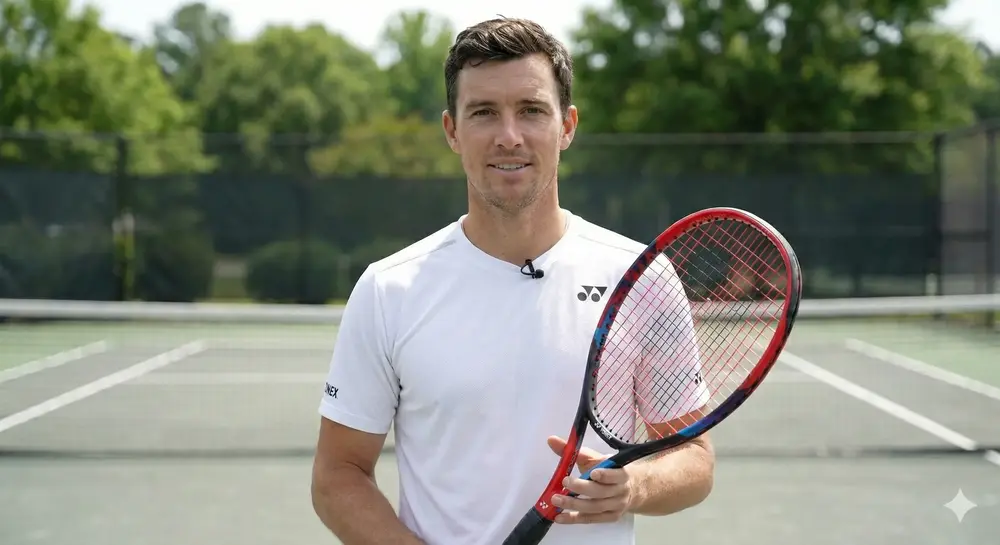
Chris Davies
Chris Davies conducts on-court playtesting and technical reviews to write guides for intermediate and advanced players. His reviews are grounded in baseline tests.