Babolat Pure Aero vs Pure Drive: Spin vs Power Shootout
Disclosure: Outbound buttons on this comparison guide link to Amazon through our secure redirect logs. RacketEdge is an Amazon Associate and earns from qualifying purchases.
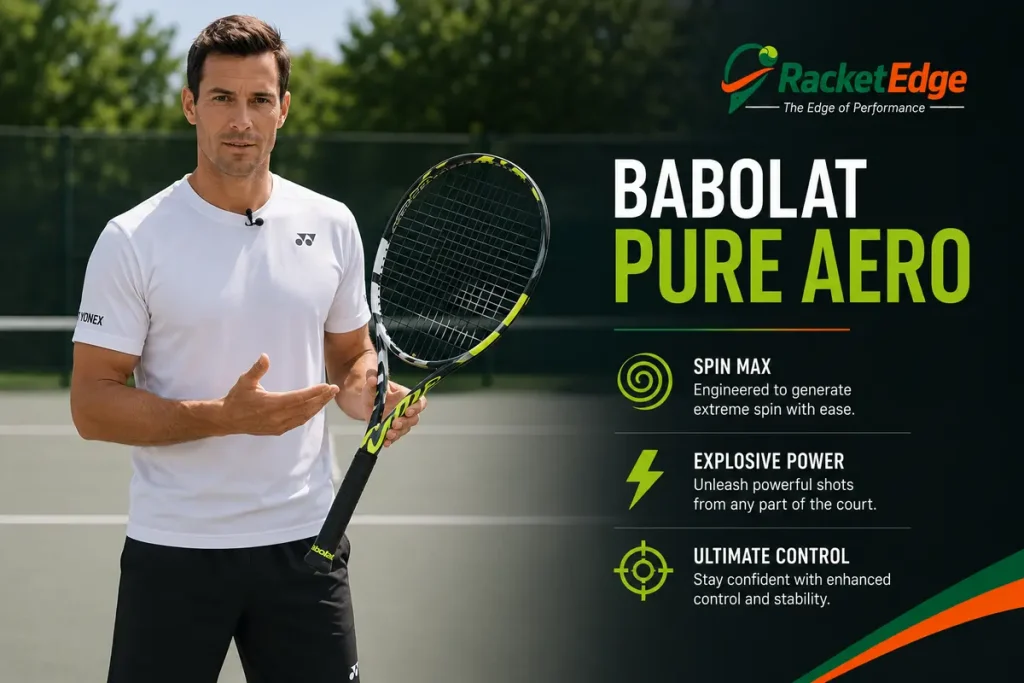
Babolat Pure Aero
- Head Size:100 sq in
- Weight (Unstrung):300g
- Stiffness (RA):65
- Swingweight:322
- String Pattern:16x19
- Balance:320mm / 7 pts HL
- Beam Width:23/26/23mm
*RacketEdge is an Amazon Associate. We earn a commission on qualifying purchases.
Babolat Pure Drive
- Head Size:100 sq in
- Weight (Unstrung):300g
- Stiffness (RA):71
- Swingweight:320
- String Pattern:16x19
- Balance:320mm / 7 pts HL
- Beam Width:23/26/23mm
*RacketEdge is an Amazon Associate. We earn a commission on qualifying purchases.
Feature-by-Feature Specs Comparison
| Feature / Performance Metric | Babolat Pure Aero | Babolat Pure Drive | Winner |
|---|---|---|---|
| Primary Focus | Topspin & Ball Grip | Easy Power & Serves | Tie |
| Frame Geometry | Aerodynamic wing shape | Rounded elliptical shape | Tie |
| Launch Angle | High (requires topspin) | Medium (more linear) | Tie |
| Stiffness & Comfort | Comfortable flex (65 RA) | Stiff, firm response (71 RA) | Babolat |
| Serving Pace | Great for kick/slice | Explosive flat first serves | Babolat |
Babolat’s yellow and blue rackets dominate tennis courts globally. If you walk into any club, you will see players using the yellow Babolat Pure Aero or the blue Babolat Pure Drive. Both weigh 300g unstrung, feature 100-square-inch heads, and use open 16x19 string patterns. On paper, they look identical.
On court, however, they represent two completely different baseline philosophies. The Pure Aero is built for spin—designed to cut through the air quickly and brush the back of the ball. The Pure Drive is built for power—designed to act as an engine, sending flat, deep drives back across the net. Hitting with the Babolat Pure Aero vs Pure Drive highlights how subtle design differences alter performance.
I spent years playtesting and stringing both of these rackets. In this comparison guide, I will break down their differences on court and help you choose the Babolat that fits your stroke style.
1. Baseline Play: Vertical Whipping vs. Horizontal Driving
When hitting groundstrokes, the biggest difference lies in the beam shape and launch angle.
The Babolat Pure Aero features an Aeromodular wing-shaped beam. The shaft is engineered to be aerodynamic, reducing drag as you swing the racket upward.
During my baseline playtests, the Pure Aero felt fast. Hitting forehands, the ball gripped the strings, cleared the net, and then dived sharply down into the court. Hitting with an open stance, the spin was outstanding. If you swing flat, the Aero is hard to control; the launch angle is high, and the ball will sail long. It demands a fast vertical swing to pull the ball back into court.
The Babolat Pure Drive utilizes a traditional elliptical beam geometry. This shape is rounded and rigid, designed to resist twisting. When you hit the ball, the frame does not flex much, transferring energy back to the ball.
The ball flight is more linear. You can hit flat baseline drives with explosive pace. It also features a more forgiving sweet spot than the Aero, making it easier to maintain depth when you are out of position or hitting on the run. If you play a style where you drive through the ball horizontally rather than brushing up, the Pure Drive is the natural choice.
2. Serving: Spin Kick vs. Explosive Pace
On serve, these two frames show their respective strengths:
- Serving with the Pure Drive: This is where the racket is legendary. The rigid frame means you lose minimal energy on impact. My flat first serves were fast and explosive. I recorded serves reaching 105 mph with the Pure Drive, maintaining excellent pace over long serving sequences. If you want free points from your serve, the Pure Drive is the ultimate weapon.
- Serving with the Pure Aero: The aerodynamic frame helps you generate head speed at the top of your serve arc. It is excellent for hitting kick and slice serves. The wide string spacing (FSI Spin) grabs the ball, allowing you to hit wide kick serves that bounce out of your opponent's reach.
3. Net Play: Crisp Volleys vs. Block Volleys
At the net, the Pure Drive's rigid frame is a major asset. When blocking back fast, heavy passing shots, the racket frame does not twist or flutter. You simply set the racket face and block the ball deep. It feels extremely solid.
The Pure Aero is highly maneuverable due to its aerodynamic shape. You can position the racket quickly during fast doubles exchanges. However, the contact feel is slightly muted compared to the Drive, making touch and drop volleys slightly harder to read, as the ball does not bounce off the string bed with the same immediate feedback.
4. Technical Analysis: Frame and Grommet Engineering
To understand why these rackets behave differently on court, we must examine their underlying technologies:
HTR System vs. Aeromodular3
- High Torsional Rigidity (HTR) System: Babolat utilizes this carbon structure in the hoop of the Pure Drive. By wrapping the graphite layup to maximize torsional stiffness, the hoop resists twisting on high-impact hits, ensuring that energy is transferred directly back into the ball for explosive power.
- Aeromodular3 Profile: The Pure Aero shaft is shaped like an airplane wing. This aerodynamic profile reduces air drag during fast swings, allowing players to accelerate the frame quickly.
FSI Power vs. FSI Spin Grommets
- FSI Power (Pure Drive): Spaced-out grommets with diamond-shaped holes that allow the strings to move more freely, expanding the sweet spot and maximizing energy return.
- FSI Spin (Pure Aero): Oblong grommets placed at the 6 and 12 o'clock hoop positions. This shape allows the main strings to slide further on impact and snap back violently, generating massive spin rotation.
Vibration Dampening: SMAC vs. Flax Inserts
- SWX Pure Feel (Pure Drive): A viscoelastic compound engineered by SMAC, integrated into the carbon layup. It filters out high-frequency vibrations but keeps the crisp, firm impact feel that Pure Drive players expect.
- NF2-Tech (Pure Aero): Natural flax fiber inserts integrated into the throat and hoop. Flax has superior shock-absorption properties compared to carbon, softening the impact feel.
5. Player Recommendations: Playstyle and Skill Level
Choosing between the two depends on your tennis background and swing mechanics:
Babolat Pure Drive Player Profile

- NTRP Level: 3.0 to 4.5
- Playstyle: Flat hitter, counterpuncher, serve-and-volleyer, or doubles specialist.
- Stroke Mechanics: Compact to medium swing paths.
- Why it fits: If you struggle to generate depth or want assistance on serves, the Pure Drive's rigid, power-focused frame does the work for you.
Babolat Pure Aero Player Profile
- NTRP Level: 3.5 to 5.0+
- Playstyle: Aggressive baseline player, topspin specialist.
- Stroke Mechanics: Full, fast vertical swings.
- Why it fits: The Aero demands that you brush up the back of the ball. The faster you swing, the more topspin you generate, creating heavy, dipping shots.
6. Comfort and Stiffness
This is a critical consideration for both rackets. Babolat frames are rigid.
- The Pure Drive has a 71 RA stiffness rating, which is on the high end of the scale. On off-center hits, the frame transmits vibration to your hand. If you have a history of tennis elbow, this frame requires caution. You must pair it with a soft multifilament string or keep your polyester string tension under 50 lbs.
- The Pure Aero has a 65 RA stiffness rating, making it slightly softer and more comfortable than the Drive. The NF2-Tech flax inserts do a great job of dampening harsh vibrations, resulting in a cleaner feel, though it is still firmer than thin-beam control frames.
7. Summary Verdict: Which Babolat Fits You?
- Choose the Babolat Pure Aero if you swing fast, hit with heavy topspin, play an aggressive baseline game, and want a racket that accelerates quickly through the air.
- Choose the Babolat Pure Drive if you want easy power, play a flatter baseline game, want to maximize your serve speed, and prefer a forgiving sweet spot.

Chris Davies
Chris Davies conducts baseline tests and service velocity diagnostics to compare performance frames. His guides provide direct comparisons to help you select a racket based on NTRP metrics.
Read Editorial Standards & Ethics Policy →