Wilson Blade vs Babolat Pure Drive: Which Fits Your Swing?
Disclosure: Outbound buttons on this comparison guide link to Amazon through our secure redirect logs. RacketEdge is an Amazon Associate and earns from qualifying purchases.
Wilson Blade 98 v9
- Head Size:98 sq in
- Weight (Unstrung):305g
- Stiffness (RA):62
- Swingweight:320
- String Pattern:16x19
- Balance:320mm / 7 pts HL
- Beam Width:21mm Flat Beam
*RacketEdge is an Amazon Associate. We earn a commission on qualifying purchases.
Babolat Pure Drive
- Head Size:100 sq in
- Weight (Unstrung):300g
- Stiffness (RA):71
- Swingweight:320
- String Pattern:16x19
- Balance:320mm / 7 pts HL
- Beam Width:23/26/23mm
*RacketEdge is an Amazon Associate. We earn a commission on qualifying purchases.
Feature-by-Feature Specs Comparison
| Feature / Performance Metric | Wilson Blade 98 v9 | Babolat Pure Drive | Winner |
|---|---|---|---|
| Power | Low to Moderate (requires fast swings) | High (effortless baseline depth) | Babolat |
| Control & Placement | Excellent (pinpoint accuracy) | Moderate (prone to flying on big swings) | Wilson |
| Arm Comfort & Feel | Plush & Connected (62 RA) | Stiff & Brassy (71 RA) | Wilson |
| Sweet Spot Forgiveness | Moderate (demanding 98 sq in) | Very High (forgiving 100 sq in) | Babolat |
| Serving Velocity | Good placement, moderate speed | Outstanding explosive power | Babolat |
For over a decade, two frames have dominated the competitive player category, representing two completely opposite philosophies of racket design. On one side stands the Wilson Blade 98, a control-oriented, flexible frame designed for players who supply their own power and prioritize precision. On the other side is the Babolat Pure Drive, a stiff, explosive powerhouse built to maximize ball speed, spin, and baseline depth. Hitting with the Wilson Blade vs Babolat Pure Drive highlights how frame stiffness alters baseline dynamics.
As a tennis coach and playtester who has strung and played with both frames across multiple generations, I see players struggle to choose between them. Selecting the wrong frame can derail your game—either leaving you short on depth with a Blade you can't swing fast enough, or spraying errors with a Pure Drive that feels too lively.
In this side-by-side playtest comparison, I will break down exactly how these two rackets compare in real game conditions, comparing their groundstrokes, serves, net play, comfort, and technical specs.
1. Groundstrokes: Baseline Rally Diagnostics
To test these frames, I spent hours playing cross-court baseline rallies. I strung both test rackets with Solinco Hyper-G (co-poly) at 52 pounds to ensure a fair comparison.
During my baseline exchanges, I made several key observations:
- The Wilson Blade 98 offers high plow-through, keeping you connected to the ball for big swings without fear of overhitting.
- The Babolat Pure Drive provides explosive ball speed, making rallies feel effortless but requiring topspin to keep deep shots inside the baseline.
The Wilson Blade 98 v9 Experience
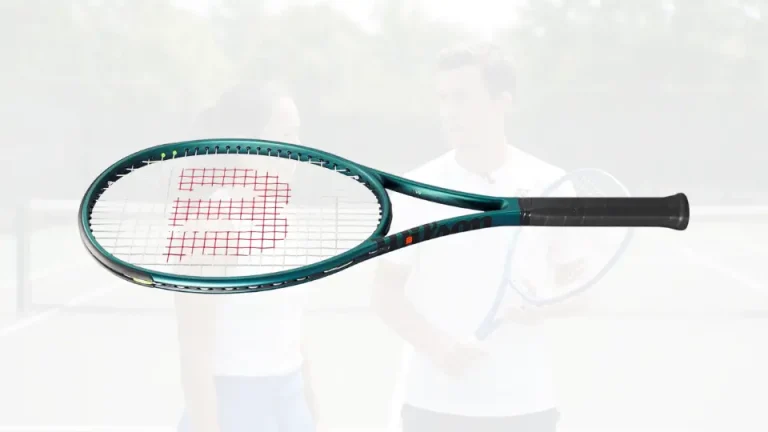
When you hit a groundstroke with the Wilson Blade 98, the first thing you notice is the flex. Measuring a comfortable 62 RA stiffness rating, the frame bends slightly on impact, holding the ball on the strings for a fraction of a second. This "pocketing" feel is what gives the Blade its legendary control.
I felt complete confidence hitting targets on my forehand side. When running wide, I could drive the ball down the line, knowing exactly where it would land. However, the Blade 98 requires a full, fast swing. If you get lazy or hit late, your ball will land short, leaving you vulnerable to attack.
The Babolat Pure Drive Experience

The Babolat Pure Drive is a completely different animal. With a stiff 71 RA rating and a thick elliptical beam, the racket returns massive energy to the ball. Even on short, defensive blocks, the ball flies deep into the opponent's court.
On groundstrokes, the Pure Drive provides effortless depth. My hitting partner immediately commented on the increased weight of my shots. However, when I tried to swing with maximum speed, I found it easy to overhit. The launch angle can feel lively, and you must brush up the back of the ball to generate topspin if you want to keep aggressive shots inside the line.
2. Return of Serve & Defensive Play: Stability vs. Deflection
Returning serves is a critical metric for competitive tennis, and these two frames behave very differently under heavy pressure:
Wilson Blade 98: Mass Absorption
When facing first serves exceeding 110 mph, the Blade 98 behaves like a shield. Its 305g unstrung weight and headlight balance allow you to absorb incoming momentum and block the ball back deep with control. Because the frame flexes, the ball does not bounce erratically off the strings, giving you time to recover your court positioning.
Babolat Pure Drive: Instant Deflection
The Pure Drive is excellent for attacking returns on second serves. The stiff frame allows you to chip and charge or drive the return with massive ball speed. However, against heavy, body-jamming first serves, the rigidity can cause the hoop to twist if you make off-center contact, spraying the return wide. It is a frame designed to deflect power quickly, requiring quick hands.
3. Serving: Raw Power vs. Target Precision
Serving is where these two frames show their opposite designs most clearly.
The Pure Drive Serves
If serving is your primary weapon, the Babolat Pure Drive is the ultimate partner. The stiff hoop and aerodynamically clean frame allow you to generate massive head speed. During my service drills, my flat first serves consistently hit the back wall with explosive pace. The high stiffness profile means you do not lose energy on impact, letting you crush flat serves down the T with minimal physical strain.
On second serves, the open 16x19 string pattern helps grip the ball, letting you hit heavy kick serves that bounce high and wide. It is an incredibly fun racket to serve with.
The Blade 98 Serves
Serving with the Wilson Blade 98 is a more precise, demanding experience. It does not provide the free speed of the Pure Drive. I had to supply my own muscle to generate pace, resulting in first serve speeds that felt slightly slower.
However, the Blade shines when it comes to placement. If you want to slice a serve wide on the Deuce court or hit a flat serve exactly on the corner line, the Blade gives you the feedback needed to make adjustments. It is a precision tool, whereas the Pure Drive is a hammer.
4. Net Game and Volleys: Maneuverability vs. Touch
At the net, both rackets perform well but suit different styles of play:
- Wilson Blade 98: Outstanding touch and redirection. The headlight balance (7 pts HL) makes it highly maneuverable, and the thin 21mm beam provides excellent feedback for drop volleys.
- Babolat Pure Drive: Punchy and stable. When blocking back hard body shots, the stiff frame keeps the volley deep. However, it lacks the delicate feel needed for drop shots.
When playing doubles, I preferred the Pure Drive for blocking fast exchanges, but in singles, the Blade allowed me to transition forward and carve out soft angles with superior precision.
5. Technical Analysis: Parallel Drilling vs. FSI Power
The physical structural differences between these two rackets are defined by their engineering:
Parallel Drilling vs. FSI Power Grommets
- Parallel Drilling (Blade): Wilson drills the grommet holes parallel to the string direction, increasing string movement and creating a more consistent, predictable string bed response. This dampens the launch angle, giving you excellent control.
- FSI Power (Pure Drive): Babolat uses diamond-shaped grommets and wider spacing. This increases string bed deflection (the trampoline effect) for massive power and spin.
Constant Beam flex vs. Elliptical Beam Rigidity
- Blade 21mm Flat Beam: A thin, constant beam that bends evenly on contact, absorbing shock and maximizing feel.
- Pure Drive 23/26/23mm Elliptical Beam: A variable beam that resists bending, transferring maximum kinetic energy directly to the ball.
6. Comfort, Stiffness, and Joint Protection
This is the most critical comparison point for many players. Stiff frames are a leading cause of joint pain.
The Babolat Pure Drive's 71 RA rating makes it one of the stiffest performance frames on the market. While Babolat has integrated vibration dampening systems, the frame still transmits significant shock to your arm on off-center hits. If you have a history of tennis elbow, I strongly advise against using a Pure Drive with a stiff polyester string.
The Wilson Blade 98 v9 is a much safer choice. Its lower 62 RA flex and built-in graphite layups absorb impact shock, protecting your forearm and wrist. I was able to play for four hours over a weekend without experiencing any arm fatigue.
7. Pros & Cons Matchup
Wilson Blade 98 v9
Pros:
- Outstanding control and target accuracy
- Plush, connected feel at contact
- Arm-friendly flex (62 RA)
- Very stable on block volleys
Cons:
- Requires a full, fast swing to generate depth
- Tighter sweet spot is unforgiving on late hits
Babolat Pure Drive
Pros:
- Effortless, explosive power on serves and groundstrokes
- Very forgiving sweet spot (100 sq in)
- Great ball speed on defensive, short strokes
- Easy to swing fast through the air
Cons:
- Stiff frame (71 RA) can trigger arm soreness
- Launch angle can feel erratic on flat groundstrokes
8. Summary Recommendation: Which Should You Buy?
Choose the Wilson Blade 98 if:
- You have a fast, full swing and generate your own power.
- You prioritize placement, directional control, and court positioning.
- You have a history of tennis elbow or shoulder fatigue.
- You play a variety of touch volleys, slices, and flat angles.
- Your skill level is 4.0 NTRP or higher.
Choose the Babolat Pure Drive if:
- You want easy depth from the baseline with minimal physical effort.
- You want to maximize your serve speed and hit heavy, deep spin shots.
- You play a lot of baseline doubles and need a stable frame to block fast volleys.
- You have a moderate swing and need help clearing the net.
- Your skill level is 3.0 to 4.5 NTRP and you have no history of arm joint pain.

Chris Davies
Chris Davies conducts baseline tests and service velocity diagnostics to compare performance frames. His guides provide direct comparisons to help you select a racket based on NTRP metrics.
Read Editorial Standards & Ethics Policy →